Monday, July 1, 2024

THE RED HERALD: Association New Peru: Some notes on a “coup d’état” in Bolivia (Corrected and expanded)


Association New Peru: Some notes on a “coup d’état” in Bolivia (Corrected and expanded)

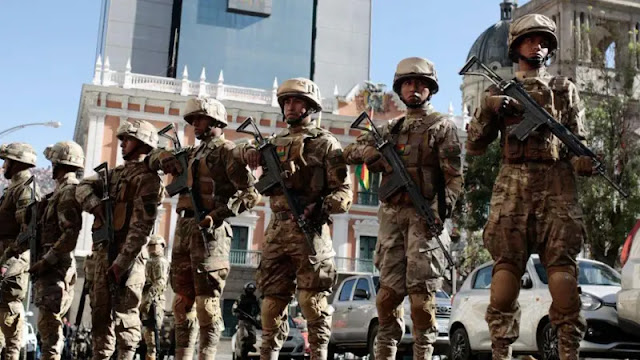
Military personnel stand guard in Plaza Murillo, located in the administrative capital of Bolivia, La Paz.

Hereby we share an article published by the Association New Peru.

Through the newscasts of various bourgeois media, we learned, on June 26, of the news of a “Coup d’état in Bolivia” in which a small number of high-ranking officers, troops and two or three tanks were involved, which after having been deployed in front of the presidential palace in Plaza Murillo have withdrawn, with the coup leader being arrested by military forces loyal to President Arce of the Movement for Socialism Party (MAS), whose leader is Hugo Morales and who is only socialist on the letterhead, because he represents the interests of the bureaucratic faction of the great native bourgeoisie.

“Bolivia lived hours of uncertainty this Wednesday after a group of military personnel mobilized in the center of La Paz, something that President Luis Arce called an attempted “coup d’état.”

Later, Arce appointed new military chiefs, including General José Wilson Sánchez, who assumed the general command of the Army.

While this act was taking place at the government headquarters, the members of the army who had mobilized in the center of La Paz began to leave Plaza Murillo.

At the time of his arrest, the military accused Luis Arce of mounting the coup attempt to “increase his popularity.” Zúñiga said it was a “self-coup.”

Former President Evo Morales – leader of the ruling party Movement to Socialism – described what happened on Wednesday as “a coup d’état” in progress.

Juan José Zúñiga had been removed as head of the Army on Tuesday after making statements against Morales and stating that “he cannot be president of this country any longer,” in reference to the former president’s aspirations to run for office again.”

A number of media outlets consulted have shown that the theory of a self-coup was later disavowed by Morales himself. And the coup was also rejected by representatives of the comprador faction of the Bolivian big bourgeoisie. The current governor of Santa Cruz, Luis Fernando Camacho, declared: “The mandate of the popular vote must be respected. Any action against it is absolutely illegal and unconstitutional,” as did former president Jorge Tuto Quiroga and even former de facto president Jeanine Añez, the former president before Arce.

OUR NOTES ON THIS:

As will be recalled, Evo Morales won the presidential elections at the end of 2005. Until before that event there was a situation of instability in all areas with continuous changes in government. In this situation, representing the bureaucratic faction of the big bourgeoisie, he assumed the government and implemented a program based on state enterprise and investment to maintain the old semi-colonial, semi-feudal society, on the basis of which a bureaucratic capitalism developed at the service of imperialism, mainly Yankee. The bourgeois economists say that the “primary-export” model continued, that is, bureaucratic capitalism and the economic policy of economic growth based on exports to the world market, whose result has been the same as always, to promote growth without economic development and, after the cycle of rising commodity prices, to return to the point from which it started.

“The economy grew significantly from 2006, and there were also significant advances in the social area. However, all this happened in an extremely advantageous external environment, now known as the super cycle of raw materials, with terms of trade extraordinarily favorable not only for Bolivia, but also for the entire region” (1)

In this way, the MAS with Morales continued the path of its predecessors, the governments of the comprador and bureaucratic factions (*).

It is important to know that the MAS is divided into two factions, one led by the current president of the country and the other by the “historical leader” of the MAS, Hugo Morales. Arce has opted for the comprador program to get out of the current economic crisis that afflicts bureaucratic capitalism in Bolivia, as will be seen in the final note of the BBC (**).

Morales was also president of the country for consecutive periods from 2005 to 2019, when due to a political crisis at the top he had to temporarily leave for Mexico and then Argentina, giving rise to a transitional government of the representative of the comprador faction of the Bolivian big bourgeoisie, Jeanine Añez, and, as agreed, new elections were called and the MAS was able to return to the government headed by Arce.

The solution to the situation of impasse in the collusion and struggle between the two factions of the Bolivian big bourgeoisie in 2019 was arranged between Hugo Morales and the head of the OAS, the servant of Yankee imperialism Almagro. Thus, the castling was monitored by Yankee imperialism through Almago.

Almagro of the OAS is the same one with whom the ronda member, counterrevolutionary and genocidal Pedro Castillo Terrones entered into negotiations, to find a way out of the situation in which he and his reactionary government found themselves, at the head of the fascist, genocidal and traitorous regime in Peru, before his reactionary “self-coup” and “counter-coup.”

Apparently, Yankee imperialism and the intelligence services of the reactionary and genocidal Army of the Peruvian State whispered in Castillo’s ear that they would support him in his “self-coup” to carry out the “counter-coup” with the fascist, genocidal and traitor Dina Boluarte. Everything indicates that this was the case: Castillo’s trip to the US, his interview with Almagro, the arrival of the OAS Commission in Lima and the report, all before the declaration of a “self-coup” on December 7, 2022. In addition, the way it happened and the statements of Castillos and the characters involved after December 7, 2022 – which seem more like the magical realism of García Marquez’s novels – despite the little that has been leaked to public knowledge and taking into account the precedent of the deceitful way in which the old Bush government proceeded with Saddam Hussein, to have a pretext to invade Iraq, this conclusion can be drawn in this regard without much fear of being wrong. Remember that the former genocidal president of the US, Bush, who was also head of the CIA, through his ambassador whispered in Saddam’s ear that if he invaded Kuwait they would not intervene.

We have made this long interpolation on the case of the “self-coup” of the rondero Castillo in Peru, due to the circumstances and the way in which the “failed coup” in Bolivia took place, which was dissipated in less than three hours. Therefore, for many it has been a staging by the reactionary president Arce and his friend General Zuñiga, giving rise to the conspiracy argument of the Argentine newspaper Página 12 (see its World section, days 26 and 27 of this month).

The reactionary newspaper El País (June 28, 2024), in its editorial article: “Bolivia returns to normality after the failed coup without solving the underlying problems”, describes the “failed coup” as “unexpected and implausible”.

Regarding these events in Bolivia, what is the responsibility of the Maoists in these situations?

In any case, regarding these events in Bolivia, we want to say that what corresponds to the revolutionaries in that country is to focus on the reconstruction of the Communist Party. That, one cannot focus on the defense of the constitution and against the coup d’état, those who proceed in this way focus on the enemy, they do not focus on the power of the people, of the masses. In the struggle for power, what is the main thing? The revolutionary struggle or the counterrevolutionary struggle for political power. Which of the two changes and transforms things? The Revolution, obviously, is that of the proletariat and this tendency develops more and more, hence the need for the CP to initiate and develop the people’s war to culminate the democratic revolution.

What we have to preach is that the P.W. is the form that corresponds to the revolutionary struggle.

In the face of fascism, fascist denial of the constitution and bourgeois laws, for the corporatization of society, applying its fascist conception and policy and developing a fascist legal system. Our position is the defense of the rights of the people and the justice that they exercise. It is not about raising bourgeois laws; we are for the conquest of power for the proletariat and the people, for the new power conquered and defended by the people’s war that supports it, for a new legal system that serves today the joint dictatorship, under the direction of the proletariat, represented by the PC, supported by the worker-peasant alliance and in perspective, the dictatorship of the proletariat.

We need a new legal system that must be a product of the Revolution. We must not fight fascism with the liberal-democratic criterion.

Then there is the dispute between the two factions, in the MAS there are positions of liberal democracy and the fascist tendency, today they are arguing about how to get bureaucratic capitalism and the Bolivian landowner-bureaucratic State out of the crisis at the service of imperialism, mainly Yankee, and at what moment to apply such and such measures. There is no monolithism (President Mao).

Is the Arce government in a position to develop a self-coup? It seems not. That has to do with how much capacity it can deceive the masses. In addition, it is not in a position because the MAS is divided

The armed forces have remained on the balcony for the most part, in those three hours of the attempted “coup” they have remained mostly on the balcony. Today the two factions, both inside and outside the MAS, are in conflict but they can collude and thus will be in conflict-collusion-etc. It is a problem of contradiction within the reaction, particularly within the big bourgeoisie, but that complicates other bourgeois and petite bourgeois sectors.

Revolutionaries must worry about mass work to promote their struggles to serve the reconstitution of the CP, now more than ever, the masses are an arena of contention, which reaction and revisionism want to tie down. Do not forget the game of contention of the imperialist powers.

Revolutionaries must not stand in the queue of any of the reactionary factions. They must expose the process, make people understand what it is about and denounce opportunism, which seeks to contain the revolution and defend the State. Opportunism does not care how much blood, shackles and hunger the masses suffer. It is the same phenomenon as the old tradition of revisionism of social democracy.

The function of the Maoists is to develop the reconstitution of the CP for the PW. Mass work must have two parts: the part of demand and the part of the fact that only the revolution can solve the problem. If we only focus on demand, we fall into a vicious circle, we advance but we lose when repression comes, it is like going back to bourgeois democracy: constitutional or bourgeois democracy under military dictatorship, or what is worse, going out through fascism. The only way to ward this off is to make the revolution. Thus, what we ultimately want to highlight is this: Bolivian society has only one way out, there is only one way out, the New Democratic Revolution, which implies satisfying the needs of the people, that is, the proletariat, the peasantry, the petite bourgeoisie, and also taking into account the interests of the national bourgeoisie, that is the only way out, there is no other; every position, every proposal of alternatives are nothing but evolutionary plans to serve the old order to maintain and develop – we are not saying develop – so that it survives, it is the problem of the evolution of the system. As Chairman Gonzalo has established:

“We are not an alternative and we will never propose alternatives, because we are not going to promote the evolution of the system, what we want is the destruction of the system, and there is no possible alternative; there is no solution, which is to destroy the old State, its backbone, the armed forces, and destroy its entire system of social relations of exploitation to create new social relations of production, that is in summary the position that we must maintain, there is no other. Many times reactionary politicians or profiteers say that we do not propose an alternative, we simply criticize, criticize, criticize, but we do not propose what alternative can be followed, of course; why?: because we are not in favor of the evolution of the system, we are in favor of its destruction and the creation of a new one, we are in favor of New Democracy, that is the reason.

In short, what we must clearly emphasize is the only way out: New Democratic Revolution.”

(1) Note: the fact that the price of exported goods from backward countries increases does not in any case, in any period, imply that the goods exported from our countries have a value equal to the goods imported from imperialist countries. This deterioration or improvement of the “terms of trade” comes from the economists of imperialism, from CEPAL, because exchange is always unequal. Marx in Capital (vol. III) wrote in this regard:

“Capital invested in foreign trade can yield a higher rate of profit because, first of all, in this case it competes with goods produced by other countries with lesser production facilities, so that the more advanced country sells its goods above their value, although cheaper than the competing countries. To the extent that here the work of the more advanced country is valued as work of greater specific weight, the rate of profit increases when the work that has not been paid as such is sold as qualitatively superior. The same relation may hold with regard to the country to which commodities are sent and from which commodities are brought; namely, that such a country supplies a greater quantity of objectified labour in kind than it receives, and thus nevertheless obtains the commodity cheaper than it could produce itself. It is just the same as the manufacturer who uses a new invention before it is generalised, and sells it cheaper than his competitors, yet nevertheless sells his commodity above its individual value, i.e., valorises as surplus labour the specifically higher productive power of the labour he has employed. In this way he realises a surplus profit. On the other hand, as regards capital invested in colonies, etc., these can yield higher rates of profit because in such places the rate of profit is generally higher on account of their low development, and the same with the employment of slaves and coolies, etc., the exploitation of labour.”

( * ) The MAS with Morales continued the path of its predecessors, the governments of the comprador and bureaucratic factions

As the study we quote says:

“Bolivia did have important cycles of boom and growth, mainly driven by increases in the international prices of raw materials. However, the surplus generated in those periods was not properly used to diversify the economy towards the secondary sector. Rather, what is observed over and over again is the substitution of one natural resource for another or, paraphrasing Gudynas (2015), diversification, but of extractivism. The sequence has been: silver ore (1825-1894), rubber (1890-1910), tin (1900-1985), natural gas (1999 to today) and soybeans (1997 to today). In general, all governments have resorted to the theme of diversification and have tried to implement some type of industrialization policy, but efforts have so far been unsuccessful. (…) limitations of the Bolivian State and the role it has played in its attempt to promote development”

“In the primary hydrocarbon link (upstream), exploitation is divided into oil and natural gas, the latter being the most significant production (98%). The strategic public company Yacimientos Petrolíferos Fiscales Bolivianos (YPFB), now present in all activities of this production chain, maintains exploration and production contracts with about a dozen national and foreign companies. 47 Foreign direct investment by these transnationals represented 31.6% of the total in 2017. In mining, zinc, 48 tin, gold, silver, lead, copper and tungsten are mainly produced. There are three different forms or groups of production: private mining (large, medium and small), national and foreign,49 mining cooperatives and state mining,50 whose average shares (period 1990-2013) with respect to the total production value were 57%, 36% and 6%, respectively (UDAPE, 2015). Foreign direct investment by foreign mining companies represented 20.7% of the total in 2017.

Since 2006, several state companies have become part of this manufacturing sector, although private companies predominate, some of which have attracted foreign direct investment in recent years, which reached 21.2% of the total in 2017.

It is also important to note that the issue of employment may be highly biased by the level of informality in the country. According to World Bank statistics (2018), informal employment, as a percentage of total non-agricultural employment, reached 77.3% on average in the period 2007-2017. This means that, outside of agricultural activity, official figures may be hiding about three-quarters of workers who provide services in other sectors, but as informal workers, which is extremely high.”

And we end this part with a quote that shows the never-ending story that can only be ended with the destruction of the three mountains: imperialism, bureaucratic capitalism and semi-feudalism:

“The positive external shock of raw material prices began to reverse from 2015 (Chart 4), but the inertia of reprimarization of the economy will surely continue for several more years. What is impossible to predict is how manufacturing exports will evolve or adapt to this new environment” (The quotes come from “Bolivia”, SERGIO G. VILL ARROEL BÖHRT, early 2019, The challenges of productive transformation in Latin America, Friedrich-Ebert-Stiftung Proyecto Regional Transformación Social-Ecológica, 2020).

Another consulted author says about the period of Morales as president and of Arce as his Minister of Economy, in Genealogy of power and geopolitics of the economy*, Raúl Prada Alcoreza, February 26, 2019; available at <https://www.pluriversidad-oikologias.es/l/genealogia-del-poder-y-geopolitica-economica/>, writes among other things:

“Specifically, the State’s greatest income is received from the export of hydrocarbon resources, mainly gas. In second place, we can note the mining resources, followed, to a lesser extent, by food products and manufactures. It can be noted that there are currently plans to develop the generation and exploitation of electric energy, with the construction of dams and hydroelectric, thermoelectric, geothermal, photovoltaic and wind plants. It is said that, in comparative terms, the Bolivian economy is the fourteenth economy in Latin America, if we take into account the nominal gross domestic product (GDP), as well as the thirteenth in terms of GDP at purchasing power parity (PPP) prices.

According to statistics provided by the National Institute of Statistics (INE) on the participation of economic activities in GDP, public administration services account for the largest share, with more than 15%, followed by agriculture, forestry, hunting and fishing with around 12%; and manufacturing industries with more than 10%. If we take into account that the share of mineral exploitation reaches more than 9% and hydrocarbon exploitation a little more than 4%, we would have that traditional extractive exploitation participates with around 14% in the formation of GDP. Thus, it turns out that traditional extractive exploitation is the second sector, after public administration services. Therefore, from the perspective of economic activities, under the focus of macro-economic indicators, the Bolivian economy appears as an economy mainly of services and extractive exploitation. That is, around 30% of the economic structure, composed of economic activities, is made up of state services and extractive exploitation. If we add to this share the share of agriculture, forestry, hunting and fishing, approximately 41% of the GDP’s composition corresponds to services and is extractive and agricultural. With the share of financial institutions, which reaches nearly 10%, the composition of more than half of the GDP turns out to be services, extractive, agricultural and financial. Only 9% corresponds to the manufacturing industry and the rest to transport and storage, trade, construction, communication and other services. If these other services, which exceed 6%, are added to state services, then the aforementioned composition reaches more than 56%. Considering other data, 17% of the share of the GDP corresponds to transport, trade, construction, electricity, gas and water and communications.

In the case of the Bolivian economic field, the preponderance of extractive activities stands out in what corresponds to the economic activities themselves and much more if it is about exports. According to Henry Veltmeyer (2015, pp. 129-130), when Morales assumed power and established his post-neoliberal regime in January 2006, backed by a social movement, around 10% of the Gross Domestic Product (GDP) and 90% of exports were in the extractive sectors of hydrocarbon exploitation and mining. By mid-2011—the middle of his second administration—this economic structure was consolidated; commodity exports, which now approached 96% of total exports, made Bolivia the most resource-dependent economy in the region. In 2011, mining accounted for 6.2% of GDP and 37.3% of exports, while the hydrocarbon sector contributed 6.9% of GDP and 45% of exports. This shows us that dependence is generated in the exchange relations: in exports and imports.

(…)

It is said that in the 2010s Bolivia is experiencing the “golden decade.” This is supported by the fact that it managed to double its GDP in just 7 years, in the period 2010-2017; and this despite the fall in the world price of a barrel of oil and the decrease in raw materials, as well as natural disasters (floods and droughts). On the other hand, Bolivia has managed to maintain a fixed and stable exchange rate for its currency against the dollar, even devaluing the US currency by 15% during the period 2006-2011, when it went from 8.06 to just 6.86. 2 But, this “golden decade” is a media cliché; one cannot ignore a long period of high prices for raw materials—which is still radiating, in terms of impact—when the fall of these prices has already begun. A “golden period” cannot last so short and then disappear as if nothing had happened, as if everything had been a fiction. What happens is that primary export economies, as defined by economists, are highly vulnerable to variations in the international market. What there was was an artificial bonanza caused precisely by the rise in the price of these raw materials; the bonanza evaporated because it was managed by a rentier State. And the fact is that a rentier State spends and enriches the rentier bourgeoisie, but it does not accumulate capital, it does not convert the State’s income into capital. In other words, it does not invest productively, although that term appears in the calculation of GDP, even in the absence of productive investment processes.

Veltmeyer (2015) states:

In order to illustrate how lucrative and beneficial a joint venture contract with Comibol [Corporación Minera de Bolivia] can be for a foreign company, Colque and Poveda analyzed the San Vicente project, operated by the Canadian firm Pan American Silver Corporation, making an assessment of the company’s profit and loss statements (projected to 2009) and based on the amount invested for the year 2018, the project’s profits from the extraction of silver and zinc could increase by 220%. This level of profit —they concluded— is the result of two conditions: the continuation of a neoliberal policy regime that allows the extraction of resources from reserves, where the exploitation costs are assumed by Comibol, guaranteeing, in effect, profits with minimal risk, and a highly favorable tax regime for foreign investors.

Veltmeyer and Petras (2015) therefore conclude that the policies of the Morales-García Linera regime in the mining sector, which to a certain extent are a continuation of the neoliberal model of previous regimes (and which could be seen as a new form of privatization rather than nationalization), have created a scenario in which the extraction and export of minerals and metals is dominated by transnationals. San Cristóbal, Sinchi Wayra and Manquiri (owned by foreigners) together account for more than half of mineral production and export, while the cooperative sector contributed 30% and the State (comibol) only 10%.

And, after the quote, the author asks:

Can we speak of sovereignty under these conditions? If the control of the country’s strategic exports is in the hands of extractive transnationals, obviously not. The sovereignty that the “progressive government” speaks of is demagogy; it is part of its populist rhetoric. What happens is that now the transnationals control the transfer of natural resources through a “revolutionary government.”

So, the question is: how are economy and power articulated? This, to put it in the usual way, without problems of conceptualization, especially taking into account the perspective of complexity.

In other words: if the extractive colonial model of dependent capitalism can be reproduced using various conservative governments, then liberal governments, then revolutionary nationalists, to continue with neoliberal governments, with the “progressive governments” taking over later (these authors call dependent capitalism to conceal the contradictions of what Maoism calls bureaucratic capitalism).

(**) NOTE ON THE COUP AND THEN ON THE CURRENT ECONOMIC SITUATION IN BOLIVIA

• June 26, 2024

Updated June 27, 2024

Bolivia experienced hours of uncertainty this Wednesday after a group of soldiers mobilized in the center of La Paz, something that President Luis Arce described as an attempted “coup d’état.”

Soldiers and military vehicles took control of Plaza Murillo in La Paz for a few hours, and entered the Palacio Quemado, the former seat of government, led by General Juan José Zúñiga, who had been dismissed as head of the Bolivian Army on Tuesday for statements he had made about former President Evo Morales.

After the start of the military actions, President Arce gave a televised speech surrounded by members of his cabinet in which he called for the mobilization of the people and said: “We are firm to confront any coup attempt.”

“We want to urge everyone to defend democracy”

Later, Arce appointed new military chiefs, including General José Wilson Sánchez, who assumed the general command of the Army.

After taking the oath of office, the military man declared: “Nobody wants to see the image that we are seeing in the streets. That is why now in my capacity as commander… I ask, order, and dispose that all personnel who are mobilized in the streets must return to their units.”

While this act was taking place at the government headquarters, the members of the army who had mobilized in the center of La Paz began to leave Plaza Murillo.

Once the troops had withdrawn, Luis Arce went out onto the presidential balcony and in front of a crowd thanked the citizens who had mobilized. Hundreds of people gathered in the vicinity of the government headquarters, despite the opposition of the rebels, who tried to block their way with tear gas.

The arrest of Zúñiga and his controversial words

At the time of his arrest, the military man accused Luis Arce of organizing the coup attempt to “boost his popularity.”

“On Sunday at La Salle school I met with the president and the president told me that ‘the situation is very screwed, this week is going to be critical. So it is necessary to prepare something to boost my popularity,'” said Zúñiga in front of the cameras during his arrest.

The general continued describing his alleged conversation with Arce, in which he asked him if they should “bring out the armored vehicles?” and Arce answered affirmatively: “Bring them out.” According to Zúñiga, that same night preparations began, mobilizing military vehicles.

Before he was taken into custody, Zúñiga said that it was a “self-coup.”

The local press claims that the general will be prosecuted for the crimes of terrorism and armed uprising against the security and sovereignty of the State, along with the former commander of the Bolivian Navy Juan Arnez Salvador.

Former President Evo Morales – leader of the ruling party Movement for Socialism – described what happened on Wednesday as “a coup d’état” in progress.

“At this moment, personnel from the Armed Forces and tanks are being deployed in Plaza Murillo. They called for an emergency meeting at the Army General Staff in Miraflores at 3:00 pm in combat uniforms,” ​​he wrote in X.

Juan José Zúñiga had been removed as head of the Army on Tuesday after making statements against Morales and stating that “he can no longer be president of this country,” in reference to the former president’s aspirations to run for office again.

“If the time comes, I will not allow him to trample on the Constitution, to disobey the mandate of the people,” Zúñiga had said in a television interview, assuring that the Armed Forces are “the armed wing of the people, the armed wing of the country,” and threatening to arrest Morales. The official rejected the dismissal and for a few more hours he remained in his office and even attended an official event.

The underlying crisis

Arce and Morales, who were once allies, have been in a political confrontation in recent months over the future of the Movement Towards Socialism (MAS) party and the former president’s attempt to aspire to a new mandate.

In various public statements, Arce said he was the target of a “soft coup” that aims to “shorten mandates” and which is supported by Morales’ followers.

In turn, the former president has denounced that Arce seeks to undermine his aspirations for a new presidential candidacy by taking over the leadership of the MAS.

Morales left power in 2019, after a military uprising following the first round of the presidential elections. He then left the country with the support of Mexico, but returned once Arce returned the MAS to power.

In parallel, Bolivia faces a serious economic crisis due to a lack of fuel and a shortage of foreign currency. This has led to union protests, for which Arce blames Morales (BBC, June 26, 2024)

On the same BBC:

• February 23, 2024

The Bolivian government adopted a series of measures this week to address the serious shortage of dollars in the country, which represent a break with the pillars of what has been its economic policy since Evo Morales’ Movement Towards Socialism (MAS) came to power in 2006.

After meeting with business groups, the Minister of Economy, Marcelo Montenegro, announced the economic reforms, which modify some of those that have been hallmarks of the government’s policy for years, such as the subsidy for the purchase of fuel and the control of exports.

Experts have been warning for some time of a deterioration in the Bolivian economy, and the change in government policy is interpreted as an attempt by President Luis Arce to straighten out the situation before the next elections in the country, scheduled for next year.

Arce thus modifies some of the economic policies that he helped design when he was Minister of Economy for former President Morales. (…)

WAS What is the economic situation in Bolivia

According to Juan Antonio Morales, “the country faces a complex macroeconomic situation due to the depletion of its international reserves and the deterioration of the trade balance.”

A concern shared by the analysts of the Fitch rating agency, who this week lowered the credit rating of the Andean country due to the “uncertainty” and “macroeconomic risks it faces.”

The government rejected the agency’s new evaluation because it did not take into account that Bolivia has “the lowest inflation in the region” or other “strengths” of its economy.

The main reason for concern is the fall in its international reserves.

Edwin Rojas, current president of the Central Bank of Bolivia (BCB), estimated the reserves at US$1.7 billion last January, when the country had around US$15 billion ten years ago. Added to this is the decline in revenue from natural gas exports.

Bolivia’s gas fields have been depleted and, after years in which revenue from gas exports underpinned sustained growth and poverty reduction during the presidency of Evo Morales (2006-2019), the country began to import more fuel than it exports, which reduced its foreign exchange earnings and worsened the shortage of dollars.

(…)

Former BCB president Juan Antonio Morales believes that “Bolivia needs these adjustment measures, even if it must take them to protect the most vulnerable.”

Jaime Dunn, however, points out that the “measures adopted are very timid and do not attack the root of the problem, which is high public spending.”

Morales doubts that the issuance of debt in dollars will have a significant impact, since “the banks and the financial sector do not trust the Central Bank much because of the amounts it already owes them.”

The expert believes that if the reforms do not work, Bolivia may have no alternative but to request assistance from the International Monetary Fund, which is anathema to the ruling party.

Adding to the uncertainty is a complicated political panorama.

The MAS split between supporters of President Arce and former President Evo Morales and the two are now rivals. Morales has criticized the government’s economic management and describes the current situation as “worse than in neoliberal times.”

According to Dunn, “Evo is skillfully exploiting discontent with the economic situation.”

The division of the ruling party has deprived the executive of the majority it would need in the National Assembly to sell the Central Bank’s gold reserves, which further limits its room for maneuver.
EL HERALDO ROJO: Asociación Nuevo Perú: Algunas notas sobre un «golpe de Estado» en Bolivia (Corregido y aumentado)


Asociación Nuevo Perú: Algunas notas sobre un «golpe de Estado» en Bolivia (Corregido y aumentado):

Militares hacen guardia en la Plaza Murillo ubicada en la capital administrativa de Bolivia, La Paz.

A continuación compartimos un artículo publicada por la Asociación Nuevo Perú.

Militares hacen guardia en la Plaza Murillo ubicada en la capital administrativa de Bolivia, La Paz.

Por los noticieros de los diversos medios burgueses nos hemos enterado, este 26 de junio ,de la noticia de un “Golpe de Estado en Bolivia” en el que estarían implicados un número reducido de altos mandos, tropas y dos o tres tanques, que luego de haberse desplegado frente al palacio presidencial de la plaza Murillo se han retirado, siendo detenido el jefe golpista por las fueras militares leales al presidente Arce del Partido Movimiento al Socialismo (MAS), cuyo líder es Hugo Morales y que de socialista no tiene más que el membrete, porque representa los intereses de la facción burocrática de la gran burguesía nativa.

“Bolivia vivió horas de incertidumbre este miércoles luego de que un grupo de militares se movilizara en el centro de La Paz, algo que el presidente Luis Arce calificó de intento de «golpe de Estado».

Más tarde,Arce designó a nuevos jefes militares, entre ellos el general José Wilson Sánchez, quien asumió la comandancia general del Ejército.

Mientras se realizaba este acto en la sede del gobierno, los miembros del ejército que se habían movilizado en el centro de La Paz comenzaron a abandonar la Plaza Murillo.

Al momento de su aprehensión, el militar acusó a Luis Arce de montar el intento de golpe para «levantar su popularidad». Zúñiga aseguró que se trató de un «autogolpe».

El expresidente Evo Morales -líder del partido oficialista Movimiento al Socialismo- calificó lo ocurrido este miércoles de «un golpe de Estado» en marcha.

Precisamente Juan José Zúñiga había sido destituido como jefe del Ejército el martes tras realizar declaraciones en contra de Morales y afirmar que “no puede ser más presidente de este país», en referencia a las aspiraciones del ex mandatario de postularse de nuevo al cargo”.

Consultados diversos medios se tiene que la teoría del autogolpe fue desautorizada después por el propio morales. Y el golpe fue rechazado también por los representantes de la facción compradora de la gran burguesía boliviana. El actual gobernador de Santa Cruz, Luis Fernando Camacho,declaró: “Se debe respetar el mandato del voto popular. Cualquier acción en contra es absolutamente ilegal e inconstitucional” y el ex mandatario Jorge Tuto Quiroga y hasta la ex presidenta de facto, Jeanine Añez, la ex-presidente antes de Arce.

 NUESTRAS NOTAS AL RESPECTO:

Como se recordará, Evo Morales ganó las elecciones presidenciales a finales de 2005. Hasta antes de ese hecho había una situación de inestabilidad en todos lo ordenes con cambios continuos de gobierno. En esa situación, en representación de la facción burocrática de la gran burguesía, asume en gobierno e implementa un programa basado en la empresa e inversión estatal para mantener la vieja sociedad semicolonial, semifeudal, sobre cuya base se desarrolla un capitalismo burocrático al servicio del imperialismo, principalmente yanqui. Los economistas burgueses dicen que continuó el modelo “primario-exportador”, es decir el capitalismo burocrático y la política económica de crecimiento económico basado en las exportaciones al mercado mundial, cuyo resultado a sido el de siempre, impulsar un crecimiento sin desarrollo económico y pasado el ciclo de la subida de precios de los comodities regresar al punto de donde se partió.

“ La economía creció de manera importante a partir de 2006, y también hubo avances significativos en el área social. Sin embargo, todo esto aconteció en un entorno externo sumamente ventajoso, conocido ahora como el superciclo de las materias primas, con términos de intercambio extraordinariamente favorables no solo para Bolivia, sino también para toda la región” (1)

De esta manera el MAS con Morales continuo el camino de sus predecesores, los gobiernos de la fracción compradora y de la burocrática (*).

Importante saber, que el MAS está dividido en dos facciones, una comandada por el actual presidente del país y la otra por el “líder histórico” del MAS, Hugo Morales. Arce se ha decantado por el programa de la compradora para salir de la actual crisis económica que aqueja al capitalismo burocrático en Bolivia, como se verá en la nota final de la BBC (**).

Morales, también fue presidente del país por períodos consecutivos desde 2005 hasta 2019, en que debido a una crisis política en las alturas tuvo que salir transitoriamente a México y luego a Argentina, dando lugar a un gobierno de transición de la representante de la facción compradora de la gran burguesía boliviana, la Jeanine Añez, y, tal como fue pactado, se convocaron a nuevas elecciones y el MAS pudo regresar al gobierno encabezado por Arce.

La salida a la situación de inpase en la colusión y pugna entre las dos facciones de la gran burguesía boliviana de 2019, fue arreglada entre Hugo Morales y el jefe de la OEA, el sirviente del imperialismo yanqui Almagro. Así, el enroque fue monitoreado por el imperialismo yanqui por intermediación de Almago.

Almagro de la OEA, es el mismo con el cual entró en tratos el rondero, contrarrevolucionario y genocida Pedro Castillo Terrones, para buscar una salida a la situación en que se encontraba él y su gobierno reaccionario, a la cabeza del régimen fascista, genocida y vendepatria en Perú, antes de su “autogolpe” y “contragolpe” reaccionarios.

Al parecer el imperialismo yanqui y los servicios de inteligencia del Ejército reaccionario y genocida del Estado peruano, le susurraron al oído a Castillo que lo apoyarían en su salida de “autogolpe”, para dar el “contragolpe” con la fascista, genocida y vendepatria Dina Boluarte. Todo indica que así fue: viaje de Castillo a los EEUU, entrevista de éste con Almagro, llegada de la Comisión de la OEA a Lima e informe, todo antes de la declaración de “autogolpe” del 07 de diciembre de 2022. Además, la forma como se produjo  y las propias declaraciones de Castillos y de los personajes implicado después del 07 de diciembre de 2022 -que más parecen propias del realismo mágico de las novelas de García Marquez-, pese a lo poco que se ha filtrado al conocimiento público y  teniendo en cuenta el antecedente de la forma tramposa como procedió el gobierno del viejo Bush con Sadam Hussein, para tener pretexto de invadir Irak, se puede sacar esta conclusión al respecto. sin mucho temor a equivocarse. Recordar, que el ex presidente genocida de los EEUU, Bush, quien fuera también jefe de la CIA, mediante su embajador le susurró al oído a Sadam, que si él invadía Kuwait no intenvendrían.

Hemos hecho esta larga interpolación sobre el caso del “autogolpe” del rondero Castillo en Perú, por las circunstancias y la forma como se ha producido el “golpe de Estado fallido” en Bolivia, que se difuminó en menos de tres horas. Por lo que, para muchos ha sido una escenificación del presidente reaccionario Arce y su amigo el general Zuñiga, dando lugar a la argumentación conspiracionista del diario argentino Página 12 (ver su sección Mundo, días 26 y 27 del presente).

 El diario reaccionario El País (28 de junio de 2024), en su artículo editorial: “Bolivia vuelve a la normalidad tras el golpe fallido sin resolver los problemas de fondo”, califica como  “inesperado e inverosímil” al “golpe de Estado fallido”.

 Sobre estos sucesos en Bolivia ¿qué corresponde a los Maoístas en esas situaciones?

En cualquiera de los casos, sobre estos sucesos en Bolivia, queremos decir, que lo que corresponde a los revolucionarios en ese país es centrar en la reconstitución del Partido Comunista. Que, no se puede centrar en la defensa de la constitución y contra el golpe de Estado, quienes proceden así centran en el enemigo, no centran en el poder del pueblo, de la masa

En la contienda por el poder ¿cuál es lo principal? la contienda revolucionaria o la contienda contrarrevolucionaria por el poder político. ¿Cuál de las dos cambia y transforma las cosas?. La Revolución, obviamente, la del proletariado y esa tendencia se desarrolla más y más, por eso la necesidad de PC para iniciar y desarrollar la guerra popular para culminar la revolución democrática.

Lo que tenemos que predicar es que la G.P. es la forma que corresponde a la lucha revolucionaria.

Frente al fascismo, negación fascista de la constitución y leyes burguesas, para corporativización de la sociedad, aplicando su concepción y política fascista y desarrollando un ordenamiento jurídico fascista. Nuestra posición es la defensa de los derechos del pueblo y la justicia que éste ejerce. No se trata de enarbolar las leyes burguesas estamos por la conquista del poder para el proletariado y el pueblo, por el nuevo poder conquistado y defendido por la guerra popular que lo sostiene, por un nuevo ordenamiento jurídico que sirva hoy a la dictadura conjunta, bajo la dirección del proletariado, representado por el PC, sustentado en la alianza obrero-campesina y en perspectiva, a la dictadura del proletariado.

Necesitamos un nuevo ordenamiento jurídico que debe ser producto de la Revolución. No hay que combatir al fascismo con el criterio demoliberal.

Después se presenta la contienda entre las dos facciones, en el MAS se expresan posiciones demoliberales y la tendencia fascista, hoy disputan en cómo sacar de la crisis al capitalismo burocrático y al Estado boliviano terrateniente-burocrático al servicio del imperialismo, principalmente yanqui, y en qué momento aplican tales o cuales medidas. No existe ningún monolitismo (presidente Mao).

¿Está el gobierno de Arce en condiciones de desarrollar un autogolpe? Parece que no. Eso tiene que ver con qué capacidad puede engañar a la masa. Además, no está en condiciones porque el MAS está dividido

Las fuerzas armadas se han mantenido en el balcón en su gran mayoría, en esas tres horas del intento de “golpe” han permanecido en su mayoría en el balcón. Hoy las dos facciones, tanto dentro como fuera del MAS, están en pugna pero pueden coludirse y así estarán de pugna-colusión- etc., es un problema de contradicción en el seno de la reacción, particularmente en el seno de la gran burguesía, pero eso complica a otros sectores burgueses y de la pequeña-burguesía.

A los revolucionarios les corresponde preocuparse del trabajo de masas para impulsar sus luchas para servir a la reconstitución del PC, ahora más que nunca, la masa es arena de contienda, que la reacción y el revisionismo quieren atar. No olvidar el juego de la contienda de las potencias imperialistas.

Los revolucionarios no deben a ponerse a la cola de ninguna de las facciones reaccionarias. Deben desenmascarar el proceso, hacer entender de qué se trata y denunciar al oportunismo que lo que busca es contener la revolución y defender el Estado. Al oportunismo no le importa cuánta sangre, cuanto aherrojamiento y hambre sufra lo masa. Es el mismo fenómeno de la tradición del viejo revisionismo de la social- democracia

La función de los maoístas es desarrollar la reconstitución del PC para la G.P., El trabajo de masas tiene que tener las dos partes: la de reivindicación y la de que solo la revolución resuelve el problema. Si solo centramos en reivindicación caemos en círculo vicioso, avanzamos pero perdemos cuando viene la represión, es como volver en torno a la democracia burgués: constitucional o o democracia burguesa bajo dictadura militar, o lo que es peor salir por fascismo. La única forma de conjurar esto es hacer la revolución.

Así, lo que finalmente queremos resaltar es esto: la sociedad boliviana tiene solo una salida, no hay sino una salida, Revolución de Nueva Democracia, que implica satisfacer las necesidades del pueblo, esto es del proletariado, del campesinado, de la pequeña burguesía y también tener en cuenta intereses de la burguesía nacional, esa es la única salida, no hay otra; toda posición, todo planteamiento de alternativas no son sino planes evolutivos para servir a que el viejo orden se mantenga y desenvuelva -no decimos se desarrolle-, para que superviva, es el problema de la evolución del sistema. Como ha establecido el Presidente Gonzalo:

“Nosotros no somos alternativa ni nunca plantearemos alternativas, porque nosotros no vamos a propiciar la evolución del sistema, lo que nosotros queremos es la destrucción del sistema, y ahí no cabe alternativa posible; ahí cabe única solución, es destrozar el viejo Estado, su columna vertebral las fuerzas armadas y destrozar todo su sistema de relaciones sociales de explotación para crear nuevas relaciones sociales de producción, esa es en síntesis la posición que debemos mantener, no hay otra. Muchas veces políticos reaccionarios o ganapanes dicen que nosotros no planteamos alternativa, simplemente criticamos, criticamos, criticamos, pero no planteamos qué alternativa puede seguirse, claro pues; ¿por qué?: porque nosotros no estamos por la evolución del sistema, estamos por su destrucción y por la creación de uno nuevo, estamos por la Nueva Democracia, esa es la razón.

En síntesis, lo que debemos nosotros resaltar claramente es la única salida: Revolución de Nueva Democracia”.

(1)Nota: el que suba el precio de los bienes exportado de los países atrasados no implica en ningún caso, en ningún período, que los bienes exportados de nuestros países tengan un valor igual a los bienes importados de los países imperialistas, eso de el deterioro o mejoramiento de los “término de intercambio” viene de los economistas del imperialismo, de la CEPAL, porque el intercambio es siempre desigual, Marx en El Capital (t. III), al respecto escribió:

“ Los capitales invertidos en el comercio exterior pueden arrojar una tasa de ganancia superior porque, en primer lugar, en este caso se compite con mercancías producidas por otros países con menores facilidades de producción, de modo que el país más avanzado vende sus mercancías por encima de su valor, aunque más baratas que los países competidores. En la medida en que aquí el trabajo del país más adelantado se valoriza como trabajo de mayor peso específico, aumenta la tasa de ganancia al venderse como cualitativamente superior el trabajo que no ha sido pagado como tal. La misma relación puede tener lugar con respecto al país al cual se le envían mercancías y del cual se traen mercancías; a saber, que dicho país dé mayor cantidad de trabajo objetivado in natura [en especie] que el que recibe, y que de esa manera, no obstante, obtenga la mercancía más barata de lo que él mismo podría produ­cirla. Es exactamente lo mismo que el fabricante que utiliza un nuevo invento antes de generalizarse, vendiendo más barato que sus competidores, no obstante lo cual vende su mercancía por encima de su valor individual, es decir que valoriza como plustrabajo la fuerza productiva específica- mente más elevada del trabajo que ha empleado. De esa manera, realiza una plusganancia. Por otra parte, en lo que respecta a los capitales invertidos en las colonias, etc., los mismos pueden arrojar tasas de ganancia más elevadas porque en esos lugares, en general, a causa de su bajo desarrollo, la tasa de ganancia es más elevada, y lo mismo, con el empleo de esclavos y culíes, etc., la explota­ción del trabajo”.

( * ) El MAS con Morales continuo el camino de sus predecesores, los gobiernos de la fracción compradora y de la burocrática

Como dice el estudio que citamos:

“ Bolivia sí tuvo ciclos de auge y crecimiento importantes, principalmente impulsados por alzas en

los precios internacionales de las materias primas. Sin embargo, el excedente generado en esos períodos no fue debidamente aprovechado para diversificar la economía hacia el sector secundario. Más bien lo

que se observa una y otra vez es la sustitución de un recurso natural por otro o, parafraseando a Gudynas (2015), la diversificación, pero de extractivismos. La secuencia ha sido: mineral de plata (1825-1894),

caucho (1890-1910), estaño (1900-1985), gas natural (1999 hasta hoy) y soya (1997 hasta hoy). En general, todos los gobiernos han recurrido discursivamente al tema de la diversifi cación y han tratado de imple-

mentar algún tipo de política de industrialización, pero los esfuerzos han sido hasta ahora infructíferos. (…) limitaciones del Estado boliviano y el rol que este ha jugado en su intento por promover el desarrollo”

“ En el eslabón primario hidrocarburífero (upstream), la explotación se

divide en petróleo y gas natural, siendo esta última la producción más

signifi cativa (98%). La empresa pública estratégica Yacimientos Pe-

trolíferos Fiscales Bolivianos (YPFB), ahora con presencia en todas las

actividades de esta cadena productiva, mantiene contratos de explora-

ción y producción con cerca de una decena de empresas nacionales y

extranjeras. 47 La inversión extranjera directa de estas transnacionales

representó 31.6% del total en 2017.

En la minería se producen principalmente zinc, 48 estaño, oro,

plata, plomo, cobre y wólfram. Hay tres formas o grupos diferencia-

dos de producción: la minería privada (grande, mediana y pequeña)

nacional y extranjera, 49 las cooperativas mineras y la minería estatal, 50

cuyas participaciones en promedio (período 1990-2013) con respecto

al total del valor de producción fueron de 57%, 36% y 6%, respectiva-

mente (UDAPE, 2015). La inversión extranjera directa de las mineras

extranjeras representó 20.7% del total en 2017

Desde 2006 varias empresas estatales pasaron a

formar parte de este sector manufacturero, aunque predominan las

compañías privadas, algunas con captación de inversión extranjera

directa en los últimos años, la cual llegó a 21.2% del total en 2017.

Asimismo, es importante advertir que el tema del empleo pue-

de estar muy sesgado por el nivel de informalidad que tiene el país.

Según estadísticas del Banco Mundial (2018), el empleo informal, co-

mo porcentaje del total del empleo no agrícola, llegó a 77.3% en

promedio en el período 2007-2017. Esto quiere decir que, fuera de la

actividad agrícola, las cifras ofi ciales pueden estar ocultando cerca

de tres cuartos de trabajadores que prestan servicios en los demás

sectores, pero en calidad de informales, lo cual es sumamente elevado.

Y terminamos esta parte con una cita que muestra la historia de nunca acabar que solo podrá ponersele término con la desrucción de la tres montanas: el imperialismo, el capitalismo burocrático y la  semifeudalidad:

“El shock externo positivo de precios de materias primas se empezó

a revertir a partir de 2015 (Grafi co 4), pero la inercia de reprimariza-

ción de la economía seguramente continuará por varios años más. Lo

que es imposible predecir es cómo las exportaciones manufactureras

evolucionarán o se adaptarán a este nuevo entorno” (Las citas provienen de “Bolivia”,

SERGIO G . VILL ARROEL BÖHRT, principios de 2019, Los desafíos de

la transformación productiva en América Latina, Friedrich-Ebert-Stiftung

Proyecto Regional Transformación Social-Ecológica, 2020).

Otro autor consultado dice al respecto del per¡iodo de Morales como presidente z de Arce como su ministro de Economia, en Genealogía del poder y geopolítica de la economía*, Raúl Prada Alcoreza, 26 de febrero de 2019; disponible en <https://www.pluriversidad-oikologias.es/l/genealogia-del-poder-y-geopolitica-economica/>, escribe entre otras cosas:

 «Concretamente, el ingreso mayor del Estado es percibido por la exportación de los recursos hidrocarburíferos, principalmente el gas. En segundo lugar, se pueden anotar los recursos mineros, seguidos, en menor medida, por los productos alimenticios y las manufacturas. Se puede anotar que actualmente se proyecta desarrollar la generación y la explotación de energía eléctrica, con la construcción de represas y plantas hidroeléctricas, termoeléctricas, geotérmicas, fotovoltaicas y eólicas. Se dice que, en términos comparativos, la economía boliviana es la decimocuarta economía de América Latina, si tomamos en cuenta el producto interno bruto nominal ( pib ), así como la decimotercera en cuanto al pib a precios de paridad de poder adquisitivo ( ppa ).

De acuerdo con las estadísticas que ofrece el Instituto Nacional de Estadística ( ine ) sobre la participación de las actividades económicas en el pib , la actividad de servicios de la administración pública registra la mayor participación, con más del 15%, seguida de agricultura, silvicultura, caza y pesca con cerca del 12%; e industrias manufactureras con más del 10%. Si tomamos en cuenta que la participación de la explotación de minerales llega a más del 9% y la explotación hidrocarburífera a un poco más del 4%, tendríamos que la explotación extractiva tradicional participa con cerca del 14% en la formación del pib . Así, resulta que la explotación extractiva tradicional es el segundo rubro, después de los servicios de la administración pública. Entonces, desde la perspectiva de las actividades económicas, bajo el enfoque de los indicadores macro-económicos, la economía boliviana aparece como como una economía principalmente de servicios y de explotación extractivista. Es decir, cerca del 30% de la estructura económica, compuesta por las actividades económicas, está conformada por servicios estatales y explotación extractivista. Si a esta participación le sumamos la relativa a agricultura, silvicultura, caza y pesca, aproximadamente el 41% de la composición del pib corresponde a servicios y es extractivista y agropecuaria. Con la participación de establecimientos financieros, que llega a cerca del 10%, la composición de más de la mitad del pib resulta ser de servicios, extractivista, agropecuaria y financiera. Solo el 9% corresponde a la industria manufacturera y el resto a transporte y almacenamiento, comercio, construcción, comunicación y otros servicios. Si estos otros servicios, que sobrepasan el 6%, se añaden a los servicios estatales, entonces la composición mencionada llega a más del 56%. Considerando otros datos, el 17% de la participación en el pib corresponde al transporte, comercio, construcción, electricidad, gas y agua y comunicaciones.

En el caso del campo económico boliviano, resalta la preponderancia de las actividades extractivistas en lo que corresponde a las actividades económicas mismas y mucho más si se trata de las exportaciones. Según Henry Veltmeyer (2015, pp. 129-130), cuando Morales asumió el poder y estableció en enero de 2006 su régimen posneoliberal, respaldado por un movimiento social, alrededor de un 10% del Producto Interno Bruto ( pib ) y un 90% de las exportaciones, se encontraba en los sectores extractivos de explotación de hidrocarburos y la minería. Para mediados de 2011 —a mediados de su segunda administración—, esta estructura económica se encontraba consolidada; las exportaciones de commodities, que ahora se acercaban al 96% de las exportaciones totales, hizo de Bolivia la economía más dependiente de los recursos naturales en la región. En 2011 la minería representa el 6.2% del pib y el 37.3% de las exportaciones, mientras que el sector de hidrocarburos contribuía con el 6.9% al pib y con el 45% de las exportaciones. Esto nos muestra que la dependencia se genera en las relaciones de intercambio: en las exportaciones y las importaciones.

(…)

Se dice que en la década de 2010 Bolivia experimenta la “década de oro”. Esto se sostiene porque habría logrado duplicar su pib en tan solo 7 años, en el periodo 2010-2017; y esto pese a la caída del precio mundial del barril del petróleo y la disminución de las materias primas, así como los desastres naturales (inundaciones y sequías). Por otra parte, Bolivia ha logrado mantener una cotización fija y estable de su moneda frente al

dólar, llegando incluso a devaluar a la divisa estadounidense en un 15% durante el periodo 2006-2011, cuando pasó de 8.06 a solo 6.86. 2 Pero, esto de la “década de oro” es un cliché mediático; no se puede obviar un largo periodo de altos precios de las materias primas —que aún se irradia, en términos de impacto— cuando ya inicia la caída de dichos precios. Un “periodo de oro” no puede durar tan poco y después desaparecer como si nada, como si todo hubiera sido una ficción. Lo que pasa es que las economías primarias exportadoras, como las definen los economistas, son altamente vulnerables a las variaciones del mercado internacional. Lo que hubo es una bonanza artificial causada precisamente por el alza de esas materias primas; la bonanza se evaporó porque era administrada por un Estado rentista. Y es que un Estado rentista gasta y enriquece a la burguesía rentista, pero no afinca capital, no convierte en capital los ingresos del Estado. En otras palabras, no invierte productivamente, aunque ese término aparezca en el cálculo del pib, incluso en ausencia de procesos de inversión productiva.

Veltmeyer (2015) afirma:

Con el fin de ilustrar cuán lucrativo y benéfico puede ser un contrato de riesgo compartido con comibol [Corporación Minera de Bolivia] para una compañía extranjera, Colque y Poveda analizaron el proyecto San Vicente, operado por la firma canadiense Pan American Silver Corporation, haciendo una evaluación de los estados de pérdidas y ganancias de la compañía (proyectados a 2009) y con base en el monto invertido para el año 2018, las ganancias del proyecto por la extracción de plata y zinc podrían incrementarse en un 220%. Este nivel de ganancia —concluyeron— es resultado de dos condiciones: la continuación de un régimen de políticas neoliberales que permite la extracción de recursos de las reservas, donde los costos de explotación los asume comibol , garantizando, en efecto, ganancias con un riesgo mínimo, y un régimen fiscal altamente favorable para los inversionistas extranjeros.

Veltmeyer y Petras (2015) concluyen, por tanto, que las políticas del régimen Morales-García Linera en el sector minero que, hasta cierto punto, son una continuidad del modelo neoliberal de regímenes previos (y que podría verse como una nueva forma de privatización en lugar de nacionalización), han creado un escenario en el cual la extracción y exportación de minerales y metales está dominada por las trasnacionales. San Cristóbal, Sinchi Wayra y Manquiri (propiedad de extranjeros) que en conjunto representan más de la mitad de la producción y exportación de minerales, mientras que el sector cooperativo contribuyó con 30% y el Estado ( comibol ) con solo 10%.

Y, luego de la cita el autor se pregunta:

¿Se puede hablar de soberanía en estas condiciones? Si el control de las exportaciones estratégicas del país está en manos de las trasnacionales extractivistas, obviamente que no. La soberanía de la que habla el “gobierno progresista” es una demagogia; forma parte de su retórica popu-lista. Lo que pasa es que ahora las trasnacionales controlan la transferencia de recursos naturales a través de un “gobierno revolucionario”.

Entonces, la pregunta es: ¿cómo se articulan economía y poder? Esto, para decirlo de la manera acostumbrada, sin problemas de conceptualización, sobre todo teniendo en cuenta la perspectiva de la complejidad.

Dicho de otra manera: si el modelo colonial extractivista del capitalismo dependiente puede reproducirse usando variadamente gobiernos conservadores, después liberales, seguidamente nacionalistas revolucionarios, para continuar con gobiernos neoliberales, tomando la posta después los “gobiernos progresistas”.(estos autores llaman capitalismo dependiente üara velar las contradicciones a lo que el maoísmo denomina capitalismo burocrático)

(**)  NOTA SOBRE EL GOLPE Y LUEGO SOBRE SITUACIÓN ECONÓMICA ACTUAL DE BOLIVIA

·                     26 junio 2024

Actualizado 27 junio 2024

Bolivia vivió horas de incertidumbre este miércoles luego de que un grupo de militares se movilizara en el centro de La Paz, algo que el presidente Luis Arce calificó de intento de «golpe de Estado».

Soldados y vehículos militares tomaron por unas horas el control de la Plaza Murillo de La Paz, y accedieron al Palacio Quemado, la antigua sede del gobierno, encabezados por el general Juan José Zúñiga, quien este martes había sido destituido como jefe del Ejército boliviano por unas declaraciones que había realizado sobre el expresidente Evo Morales.

Tras el inicio de las acciones de los militares, el presidente Arce dio un discurso televisado rodeado de los miembros de su gabinete en el que pidió la movilización del pueblo y dijo: «Estamos firmes para enfrentar todo intento golpista».

«Queremos exhortar a todos a que defendamos la democracia“

Más tarde,Arce designó a nuevos jefes militares, entre ellos el general José Wilson Sánchez, quien asumió la comandancia general del Ejército.

Luego de jurar el cargo, el militar declaró: “Nadie desea ver la imagen que estamos viendo en las calles. Es por eso que ahora en mi condición de comandante… pido, ordeno, dispongo, que todo el personal que se encuentra movilizado en las calles debe retornar a sus unidades”.

Mientras se realizaba este acto en la sede del gobierno, los miembros del ejército que se habían movilizado en el centro de La Paz comenzaron a abandonar la Plaza Murillo.

Una vez se habían retirado las tropas, Luis Arce salió al balcón presidencial y frente a una multitud dio las gracias a los ciudadanos que se movilizaron. Cientos de personas se congregaron en las inmediaciones de la sede del gobierno, pese a la oposición de los sublevados, los cuales intentaron cerrarles el paso con gases lacrimógenos.

La detención de Zúñiga y sus polémicas palabras

Al momento de su aprehensión, el militar acusó a Luis Arce de montar el intento de golpe para «levantar su popularidad».

“El día domingo en el colegio La Salle me reuní con el presidente y el presidente me dijo que ‘la situación está muy jodida, esta semana va a ser crítica. Entonces es necesario preparar algo para levantar mi popularidad’”, dijo Zúñiga frente a las cámaras durante su arresto.

El general continuó describiendo su supuesta conversación con Arce, en la que le preguntó si debían “¿sacar los blindados?” y éste le respondió afirmativamente: “Sacá”. Según Zúñiga, esa misma noche comenzaron los preparativos, movilizando vehículos militares.

Antes de que se lo llevaran detenido, Zúñiga aseguró que se trató de un «autogolpe».

La prensa local asegura que el general será procesado por los delitos de terrorismo y alzamiento armado contra la seguridad y la soberanía del Estado, junto al excomandante de la Armada boliviana Juan Arnez Salvador.

FUENTE DE LA IMAGEN,REUTERS

El expresidente Evo Morales -líder del partido oficialista Movimiento al Socialismo- calificó lo ocurrido este miércoles de «un golpe de Estado» en marcha.

«En este momento se despliega personal de las Fuerzas Armadas y tanquetas en la Plaza Murillo. Convocaron a las 3:00 pm a reunión de emergencia en el Estado Mayor del Ejército en Miraflores con uniformes de combate», escribió en X.

Precisamente Juan José Zúñiga había sido destituido como jefe del Ejército el martes tras realizar declaraciones en contra de Morales y afirmar que “no puede ser más presidente de este país», en referencia a las aspiraciones del exmandatario de postularse de nuevo al cargo.

«Llegado el caso no permitiré que pisotee la Constitución, que desobedezca el mandato del pueblo”, había dicho Zúñiga en una entrevista televisiva, asegurando que las Fuerzas Armadas son «el brazo armado del pueblo, el brazo armado de la patria,» y amenazando con arrestar a Morales.

El oficial rechazó destitución y durante unas horas más continuó en su despacho e incluso asistió a un acto oficial.

La crisis de fondo

Arce y Morales, que alguna vez fueron aliados, han sostenido una confrontación política en los últimos meses por el futuro del partido Movimiento al Socialismo (MAS) y el intento del expresidente de aspirar a un nuevo mandato.

En diversas declaraciones públicas, Arce dijo ser objeto de un “golpe blando” que tiene como objetivo “acortar mandatos” y tras el cual estarían los seguidores de Morales.

A su vez, el expresidente ha denunciado que Arce busca socavar sus aspiraciones a una nueva candidatura presidencial a través de la toma de la dirección del MAS.

Morales dejó el poder en 2019, luego de una alzamiento militar tras la primera vuelta de las elecciones presidenciales. Entonces abandonó el país con apoyo de México, pero regresó una vez que Arce devolvió al poder al MAS.

De manera paralela, Bolivia enfrenta una grave crisis económica por falta de combustibles y escasez de divisas. Esto ha generado movilizaciones sindicales de las que Arce responsabiliza a Morales (BBC, 26 de junio 2024)

En la misma BBC:

·                     23 febrero 2024

El gobierno de Bolivia adoptó esta semana una serie de medidas para hacer frente a la grave escasez de dólares en el país que suponen una ruptura con los pilares de la que ha sido su política económica desde que el Movimiento al Socialismo (MAS) de Evo Morales llegó al poder en 2006.

Tras reunirse con colectivos empresariales, el ministro de Economía, Marcelo Montenegro, anunció las reformas económicas, que modifican algunas de las que han sido señas de identidad de la política del gobierno durante años, como el subsidio a la compra del combustible y el control de las exportaciones.

Los expertos llevaban tiempo alertando de un deterioro de la economía boliviana, y el giro en la política del gobierno se interpreta como un intento del presidente Luis Arce de enderezar la situación antes de las próximas elecciones en el país, previstas para el año que viene.

Arce modifica así algunas de las políticas económicas que ayudó a diseñar cuando era ministro de Economía del expresidente Morales.(…)

FUE Cual es la situación económica de Bolivia

Según Juan Antonio Morales, “el país se enfrenta a un cuadro macroeconómico complejo por el agotamiento de sus reservas internacionales y el deterioro de la balanza comercial”.

Una preocupación compartida por los analistas de la agencia de calificación Fitch, que esta semana rebajaron la calificación crediticia del país andino ante la “incertidumbre” y los “riesgos macroeconómicos que enfrenta”.

El gobierno rechazó la nueva evaluación de la agencia porque no tuvo en cuenta que Bolivia tiene “la inflación más baja de la región” ni otras “fortalezas” de su economía.

El principal motivo de preocupación es la caída de sus reservas internacionales.

Edwin Rojas, actual presidente del Banco Central de Bolivia (BCB), cifró el pasado enero en US$1.700 millones las reservas, cuando el país llego a tener alrededor de US$15.000 millones hace diez años. A eso se suma el descenso de los ingresos por las exportaciones de gas natural.

Los yacimientos bolivianos se han ido agotando y, después de años en los que los que los ingresos de las exportaciones de gas cimentaron el crecimiento sostenido y la reducción de la pobreza durante la presidencia de Evo Morales (2006-2019), el país empezó a importar más combustibles del que exporta, lo que redujo sus ingresos en divisas y agravó la escasez de dólares.

(…)

El expresidente del BCB Juan Antonio Morales cree que “Bolivia necesita estas medidas de ajuste, aunque deba tomarlas protegiendo a los más vulnerables”.

Jaime Dunn, sin embargo, señala que las “medidas adoptadas son muy tímidas y no atacan la raíz del problema, que es el elevado gasto público”.

Morales duda que la emisión de deuda en dólares vaya a tener un impacto significativo, ya que “la banca y el sector financiero no se fían mucho del Banco Central por las cantidades que ya les adeuda”.

El experto cree que si las reformas no dan resultado puede que a Bolivia no le quede alternativa que solicitar el auxilio del Fondo Monetario Internacional, lo que supone un anatema para el oficialismo.

A la incertidumbre se suma un complicado panorama político.

El MAS se escindió entre los partidarios del presidente Arce y el expresidente Evo Morales y ambos son ahora rivales. Morales ha criticado la gestión económica del gobierno y describe la situación actual como “peor que en épocas neoliberales”.

Según Dunn, “Evo está explotando hábilmente el descontento con la situación económica”.

La división del oficialismo ha privado al ejecutivo de la mayoría que necesitaría en la Asamblea Nacional para vender las reservas en oro del Banco Central, lo que limita aún más su margen de maniobra.