
The IDB and Interpol Expand Their Intervention in Brazil
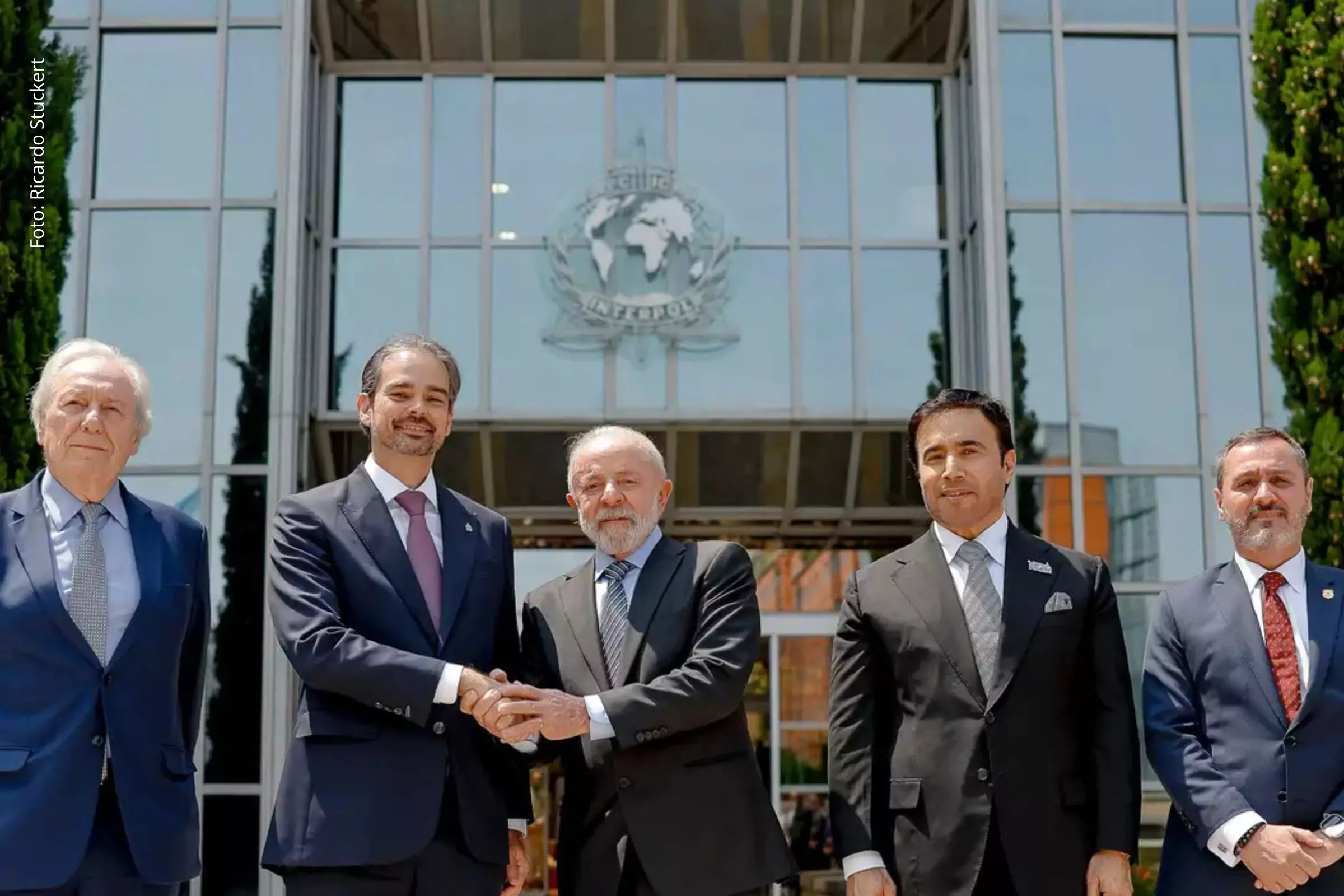
Featured image: Representatives of the Brazilian government pose in front of Interpol headquarters in Lyon, France, during an official visit. This closer relationship with international law enforcement agencies comes amidst deepening cooperation between the established old Brazilian State and foreign police forces. Source: Ricardo Stuckert via AND
Brazil is expanding its cooperation with international security institutions with the pretext of “fighting organized crime”. Behind this initiative, however, lies a much larger imperialist intervention, mainly Yankee. The new agreement with the Inter-American Development Bank (IDB) involves around 5 billion Brazilian reais to expand a supposed joint action against so-called “organized crime,” while the IDB has announced that its security investments across Latin America and the Caribbean will rise to 4 billion USD spanning three years.
A memorandum of understanding was signed in July this year between the Brazilian government and the IDB at the 3rd Regional Summit of the Alliance for Security, Justice and Development. The agreement contains the integration of the imperialist agency Interpol into the Rapid Response Task Force Against Violence and Organized Crime, a mechanism linked to the Alliance.
This agreement also links with Luiz Inácio da Silva’s “Brazil Against Organized Crime” program, launched in 2026 with over a billion reais in funding. The program expands Brazil’s repressive security measures through harsher anti-faction laws and increased international cooperation, including with Yankee imperialism.
The enormous financial resources involved show that this is not simply a small technical cooperation program. Billions of reais are being directed toward policing, investigations, prison security, and financial surveillance. Such investments give imperialists a growing role in shaping policies inside Brazil and throughout Latin America and are a step toward greater foreign subjugation and repression, mainly Yankee imperialism.
From an anti-imperialist perspective, this development must be viewed in the context of longstanding Yankee intervention in Latin America. For decades, the United States and institutions connected to its political and economic sphere have promoted cooperation against “drugs”, “organized crime” and “terrorism” as a means of expanding their influence over the security apparatuses of Latin American countries.
Foreign funding, intelligence cooperation and international security programs create dependencies–equipments such as ScanEagle don’t even operate without the Pentagon– while allowing external powers to gain greater access to national institutions and security policies. The new agreement is part of a wider regional trend. The growing presence of Yankee-institutions in Latin America, represents another step toward subordinating the region’s sovereignty to the interests of the sole hegemonic superpower.
AND points out that the use of crime, especially so-called “drug trafficking,” as a justification for US interactions is historically known for masking their real intentions: the implementation of counterinsurgency policies, pointing out the similarities to the Yankee led counterinsurgency cooperation against the People’s War in Peru. Noting in addition, that the recent invitation of the 60 countries to coordinate against the “resurgence of the far left” reveals the real target of Yankee imperialism.
Latin America has great significance to Yankee imperialism and it’s hegemony. The combative movements, especially the struggle for land over all and the Agrarian Revolution in Brazil therefore, are a target of these “security cooperation.” Multiple Brazilian lackey politicians have pointed to by relentlessly striving to link the struggle for land organizations to common criminal activity and drug trafficking in an effort to criminalize and suppress organizations that challenge the power of the big landlords.
During A Propósito #369 , broadcast on July 16th on the AND channel , the newspaper’s representative stated that “here in Brazil, there is a real peasant war for land, and they are also keeping an eye on that.”
El BID y la Interpol expanden su intervención en Brasil
Imagen de cabecera: representantes del gobierno brasileño posan frente a la sede de Interpol en Lyon, Francia, durante una visita oficial. Esta relación más estrecha con los organismos internacionales encargados de la aplicación de la ley se produce en un contexto de cooperación cada vez más estrecha entre el viejo Estado brasileño y las fuerzas policiales extranjeras. Fuente: Ricardo Stuckert via AND
Brasil está ampliando su cooperación con instituciones internacionales de seguridad con el pretexto de “luchar contra el crimen organizado”. Sin embargo, detrás de esta iniciativa se esconde una mayor intervención imperialista, yanqui. El nuevo acuerdo con el Banco Interamericano de Desarrollo (BID) supone unos 5.000 millones de reales brasileños para ampliar una supuesta acción conjunta contra el denominado “crimen organizado”, mientras que el BID ha anunciado que sus inversiones en seguridad en toda América Latina y el Caribe ascenderán a 4.000 millones de dólares estadounidenses a lo largo de los próximos tres años.
En julio de este año se firmó un memorando de entendimiento entre el gobierno brasileño y el BID en la IIIª Cumbre Regional de la Alianza para la Seguridad, la Justicia y el Desarrollo. El acuerdo prevé la integración de la agencia imperialista Interpol en el Grupo de Trabajo de Respuesta Rápida contra la Violencia y el Crimen Organizado, un mecanismo vinculado a la Alianza.
Este acuerdo también está vinculado al programa de Luiz Inácio da Silva, “Brasil contra el Crimen Organizado”, puesto en marcha en 2026 con una financiación de más de mil millones de reales. El programa amplía las medidas de seguridad represivas de Brasil mediante leyes más duras contra las bandas y una mayor cooperación internacional, incluyendo con el imperialismo yanqui.
Los enormes recursos financieros que se están destinando a ello demuestran que no se trata simplemente de un pequeño programa de cooperación técnica. Se están destinando miles de millones de reales a la policía, las investigaciones, la seguridad penitenciaria y la vigilancia financiera. Estas inversiones otorgan a los imperialistas un papel cada vez más importante en la configuración de las políticas dentro de Brasil y en toda América Latina, y suponen un paso hacia una mayor subyugación y represión por parte de potencias extranjeras, principalmente el imperialismo yanqui.
Desde una perspectiva anti-imperialista, este fenómeno debe analizarse en el contexto de la prolongada intervención yanqui en América Latina. Durante décadas, Estados Unidos y las instituciones vinculadas a su esfera política y económica han promovido la cooperación en la lucha contra las “drogas”, el “crimen organizado” y el “terrorismo” como medio para ampliar su influencia sobre los aparatos de seguridad de los países latinoamericanos.
La financiación extranjera, la cooperación en materia de inteligencia y los programas de seguridad internacional crean dependencias —equipos como el ScanEagle ni siquiera funcionan sin el Pentágono—, al tiempo que permiten a potencias externas obtener un mayor acceso a las instituciones nacionales y a las políticas de seguridad. El nuevo acuerdo forma parte de una tendencia regional más amplia. La creciente presencia de instituciones yanquis en Latinoamérica, representa un paso más hacia la subordinación de la soberanía de la región los intereses de la superpotencia hegemónica única.
Y señala que el uso de la delincuencia, especialmente el denominado “narcotráfico”, como justificación para las intervenciones estadounidenses es conocido históricamente por encubrir sus verdaderas intenciones: la aplicación de políticas de contrainsurgencia, destacando las similitudes con la cooperación en materia de contrainsurgencia liderada por los yanquis contra la Guerra Popular en Perú.
Cabe señalar, además, que la reciente invitación a 60 países para coordinarse contra el «resurgimiento de la extrema izquierda” revela el verdadero objetivo del imperialismo yanqui.
América Latina reviste una gran importancia para el imperialismo yanqui y su hegemonía. Los movimientos combativos, especialmente la lucha por la tierra en general y la Revolución Agraria en Brasil, son, por lo tanto, un objetivo de esta “cooperación en materia de seguridad”. Múltiples políticos lacayos brasileños al esforzarse sin descanso por vincular a las organizaciones de lucha por la tierra con la delincuencia común y el tráfico de drogas, en un intento por criminalizar y reprimir a las organizaciones que desafían el poder de los grandes terratenientes.
Durante el programa “A Propósito” nº 369, emitido el 16 de julio en el canal AND, el representante del periódico afirmó que “aquí en Brasil hay una auténtica guerra campesina por la tierra, y también están pendientes de eso”.